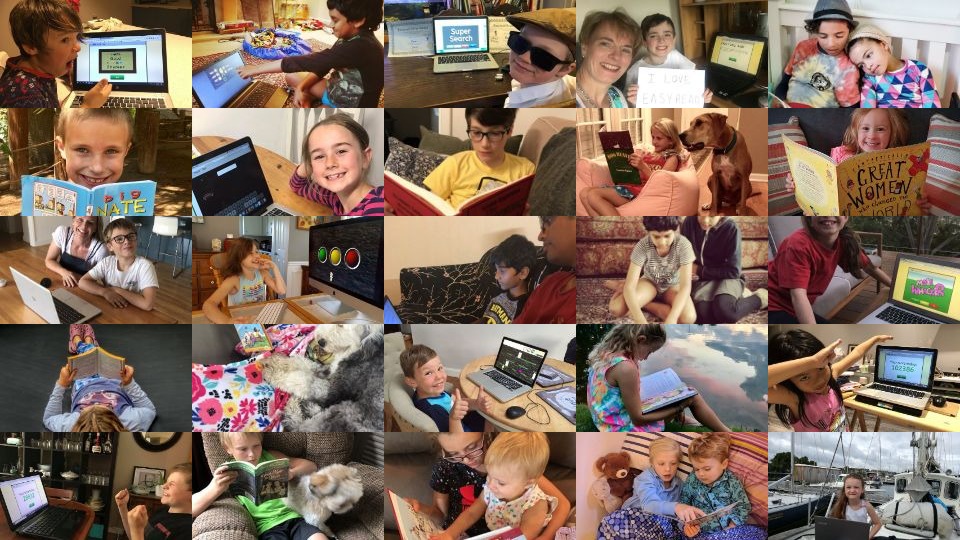
I can’t begin to tell you what a difference Easyread has made in our lives. P was once struggling significantly in both reading and spelling. After just a handful of weekly Easyread lessons, I noticed a difference. School is now out for summer break and report cards have been delivered. P can proudly say he received a 94 in reading and comprehension and a 96 average in spelling! Thank you Easyread!
I have been working hard…
I have been working hard. I have just finished the end of grade test I was not very successful last year. I did not feel good about it last year. But this year, I rocked it! I have been working hard in easy read and “its working.” I no longer get mad or frustrated because I couldn’t do it, I am doing it. Hopefully, we can get online again and meet each other.
Thank you for your help and encouragement,
M
Writing is now fun!
hi Sarah
i like writing now it is very fun!!
from matthew
She has really turned a corner…
Mikayla is progressing really nicely at the moment. I am scared to say it, but I think she has really turned a corner. Fingers crossed!!!!
- J
Case Study: From lagging behind to leading the pack
Wills had been running away from reading his whole life. Nowadays, thanks to Easyread, he’s the leader of the pack!
When it came to reading, Wills had always managed to ‘get by’ rather than really enjoying it. As far as phonics was concerned – he just never got it. From age 6 he would only read when he absolutely had to. As soon as a reading or writing activity was proposed Wills could instantly become anxious and surly, and would begin guessing regularly.
All in all, reading and writing were a drag.
Despite this, his reading age was about the same as his natural age and so the school were not concerned. What Mum Jacky found odd however was the fact that in every other area of his learning Wills was way ahead of the curve, positively excelling in all non-language related subjects. Why should reading be any different?
Then from Year 3 of primary school Jacky noticed that Wills’ spelling had begun to fall badly behind. Given that there was a history of dyslexia in the family, she wondered if this was what they were dealing with here. However his teachers felt this was not the case. They said she was best not to worry too much about the accuracy of Wills’ writing, lest it “stunt his imagination”. Ultimately he would catch-up. Jacky was far from keen to have her son tested and “labelled” as dyslexic, having seen first-hand the negative repercussions this could have on a person’s confidence. So she accepted this hopeful view, and let things carry on as they were.
In no time at all, the Year 6 SATs had come round and boy were they tough. From then on, anything and everything that related to reading and writing began to spiral out of control. Every literacy assignment or piece of reading homework ended with tears of frustrated anger and Wills’ confidence plummeted with every defeat.
Reading and writing were no longer just a drag; literacy was standing in the way of everything.
Jacky’s first thought was to recruit a tutor, and as such they found an absolutely lovely lady to conduct a weekly session with Wills. Every week he complained bitterly, avoiding the task at hand desperately. One particularly bad week he actually ran away in an attempt to avoid the problem; but of course it didn’t go away.
In spite of many trials and tribulations, Wills did manage to scrape a level 4 in his year 6 Literacy SATs. However upon being retested at secondary school, it was revealed that whilst his reading age was age appropriate, his spelling was 5 years behind. This was despite being an A student in all other subjects. Finally Wills and Jacky acknowledged that he had significant problems with spelling. What’s more, by this point Wills was refusing to read in front of anyone.
Aware now that the problem wasn’t going to get better by itself, Jacky did some hunting around online and accidentally stumbled across Easyread.
For the first time, she could see that her son’s literacy problems weren’t unique and that in fact the the solution was obvious; in order to spell, Wills needed to relearn how to read phonetically!
What’s more, rather than finishing the trial lesson a crying mess (which was the norm) Wills was sat tall in his computer chair with a beaming smile on his face. Jacky signed up in a New York minute!
The Solution
Jacky and Wills instantly liked the fun format, regular prizes and the fact the sessions were short – 10 minute lessons 5 times a week was totally manageable. Wills knew that despite their hectic schedule, he would be guaranteed Jacky’s undivided attention for the Easyread slots, and so they both started looking forward to this time. To be facing the problem together really spurred him on.
A few weeks into the course, Wills suddenly revealed that words moved on the page every time he read, and that he was always the slowest in his class at reading. How could Jacky have never known this! She spoke with the support team, who provided helpful practical suggestions such as investing in some coloured overlays and improving his eye-tracking ability with a few simple physical exercises, all of which made a noticeable difference.
Sure enough, day by day Wills’ reading sped up. By lesson 100 his confidence was soaring and by lesson 180 his spelling had improved too. After a year on the program he was moved into the A stream at school.
Wills and Jacky stayed with the program for 15 months in total. The Easyread staff kept in touch the whole way through and their wealth of experience with children like Wills was hugely reassuring for Jacky.
It had never occurred to them that in order to improve Wills’ spelling they needed to change the way he was reading. But by the end of the course Jacky was left in no doubt that this was the process her son had undergone, and which had saved him.
And now?
For the first time in his life, Wills reads for pleasure. His confidence has dramatically improved too, and his teachers have noticed a step-change in the range of vocabulary he uses in his written work. Now he has the expertise and self-assurance to spell complex words; nothing can hold him back!
For Jacky and 13 year old Will, the journey has been a long one. So was it really all worth it? Well, this April saw Wills’ being presented with the “Star in English Award” in his class. For Jacky, there is no question.
—-
Laura O’Sullivan enjoys coaching students and parents like Wills and Jacky in her role as a System Coach for Easyread, an online course for children who need support for spelling and/or reading problems due to highly visual learning styles, dyslexia, auditory processing disorders and more. www.morganlearning.com
Great progress today!…
I just had to write to tell you that Joseph had a fantastic lesson today. He didn’t struggle with the story and he then whizzed through the Mushroom Picker game without any mistakes. For the first time he was talking throughout the whole game about the words and reading them aloud. Great progress today!
- V
There are no battles any more!…
Andre is still happy to do Easyread. We have a good routine of him reading a few pages of the book series Boyz Rule with his Dad in the morning, and then we do Easyread together. Andre is not guessing with Easyread at all because he knows he will only loose a life on the game if he does!
We are very happy with Easyread and we feel that it is making a difference. We are all working together happily now, there are no battles any more and Andre is reaping the rewards. Ralf even came to me the other morning and said that Andre wanted to keep reading, and so asked me to take over since he had to go to work. Never before has Andre wanted to keep reading himself!
Also, I am buying the Boyz Rule series from a bookshop where, after buying so many books, you get a voucher for another purchase. I told Andre he could have the voucher for being so great all the time, and he could choose anything he wanted. I presumed it would be a science or craft book but he said he wanted another Boyz Rule book…a reader! I nearly fell over.
So, all is well here and thank you.
- T
Supporting a Child with Reading Difficulties
by Brigid Hekster, Chartered Psychologist
For most parents one of the hallmarks of their child’s early success in the primary school years is a progression from reading books aimed at teaching reading to becoming a free reader. Sometimes difficulties with literacy may emerge very early on in a child’s school career alerting parents and educational professionals to a developmental problem or learning difficulty. However, for other children there may be early success with reading and a gradual tailing off in progress with a more puzzling or insidious onset of reading difficulties. Understanding clearly the symptoms and origins of reading difficulties in children continues to be a challenge for researchers and education professionals. Although much is known about a range of potential warning signs that can prove indicative of later problems with reading (from spelling and speech difficulties to organisational and co-ordination problems), these are by no means comprehensive.
Every child facing these difficulties will display a different range of early symptoms, and the severity, timing and frequency of these can vary hugely between individuals. This often means that recognising and diagnosing a child with a reading impairment can be difficult. All children will face some challenges when learning and developing their reading skills, and confusion can often arise between those facing frustrating but routine challenges with reading, and those who are struggling with more enduring difficulties.
These on-going challenges in early detection and diagnosis have led some to focus more on what can be done to support children in the range of areas that often suffer as a result of facing reading difficulties (Nash, Stengelhofen, Brown & Toombs 2002). Aside from the educational impact that a reading impairment can have on developing literacy skills and accessing the school curriculum, increasing evidence suggests that the effects can be more extensive. In particular attention has been given to the impact that difficulties around reading can have on self-esteem and confidence.
Emotional Effects of Reading Difficulties
Nash et al (2002) have proposed a model that suggests that the experience of having a reading difficulty can make a child feel victimised, which can lead to feelings of exclusion or of being ostracised. In turn, this can lead to a child feeling stigmatised or discredited in comparison to those around them. This is known as the VOS (victimisation, ostracised, stigmatised) cycle. This cycle can impact on a child’s confidence, their subsequent behaviours and their social relationships leading to feelings of failure and underachievement. It can also increase levels of frustration and anger which can manifest themselves through disruptive and aggressive behaviours.
Being a parent or carer for a child who is struggling to progress with reading can be a worrying and anxiety provoking experience. Our natural instinct is often to become protective and to highlight the differences that we notice in our children with the aim of identifying the problem and accessing appropriate help. Of course, it is crucially important to seek appropriate professional advice if you notice that you child is struggling in any area of their educational or social development. Recent research has also shown that children facing learning difficulties can be very sensitive to parental anxiety and to feelings that they are somehow ‘different’ from other children. Parental anxiety and sometimes frustration also inevitably creeps into the way we might listen to, or try to support our children with their home reading practice. Reading can then become a progressively unrewarding and anxiety provoking experience for the child. It is therefore crucial that parents get support as well, not only to manage their own anxiety but because maintaining a calm and positive approach can have a positive impact on the child.
Every Child Can Learn
A wave of research in recent years, starting with Lipson and Wixson (1986) and developed by Chapman (2000), has pointed to the more wide reaching impact of reading difficulties to suggest ways in which we can support and help children facing these difficulties. The suggestion in this research is that there are no set or predetermined causes for reading difficulties that are irreversible or permanently entrenched. Instead, these problems arise out of a combination of biological, social and psychological factors that will vary from child to child. These factors can emerge and change over time, sometimes exacerbating the problem and sometimes working to reduce negative impact.
Giving the Right Kind of Support to Your Child
Chapman (2000) suggests that by working to change factors that make a child feel excluded and isolated (usually related to the child’s social environment and general wellbeing) significant improvements can be made in a child’s attainment in reading. This might include help and support for parents to reduce parental stress and improve confidence. Another example might be to focus on aspects on learning that those with reading difficulties often excel in, such as visual memory. Using images in conjunction with reading materials can help identification and engagement, as well as giving the child a sense of achievement and enjoyment. This in turn can improve confidence and reduce feelings of alienation from reading tasks both inside and outside of the classroom.
Nash et al (2002) showed that regardless of the length of time a reading difficulty has been persisting, providing structured support aimed at reducing feelings of being ostracised, victimised and stigmatised, can have a real impact in improving reading attainment. Through supporting a child to improve their feelings of self-worth and achievement, reading difficulties can be reduced as engagement improves and confidence to explore alternative ways of learning increases.
—–
Brigid Hekster, www.insightlondon.co.uk
Bsc. (Hons); MSc. Clin Psych; CPsychol; AFBPsS
Chartered Psychologist
HPC Registered Clinical Psychologist
THANK YOU!
I am very happy with the system. Mercedes is eager to read now and taking out books with less pictures. She reads more fluently than before! Thank you for getting her confidence back! THANK YOU!
- A
I just wanted to say Thank You !!!!
I just wanted to say Thank You !!!! for all your support over the course we under took and to let you know that M wants to stop her lessons. School is winding down and the summer is fast approaching, She wants to do several activities this summer and wants to read different books from the library. I’m not sure how to go about ending the lessons. She has improved so much, it amazes
me how much she’s learned.
Please let me know what I need to do to cancel easy read. (she did recieve the helicopter yesterday, but hasn’t opened it yet)
Thank You once again!!!!
J